

Key Takeaways
Good BMW parts for repair shops are selected through fitment checks, quality review, cost analysis, and careful installation planning.
- Confirm part numbers, supersessions, model year, and chassis compatibility before ordering.
- Compare suppliers by total cost, catalog accuracy, delivery reliability, warranty terms, and support.
- Inspect packaging and components before installation, especially when a part has safety or electronic implications.
- Track inventory, comebacks, warranty claims, and delays to protect repair-shop margins.
- Account for programming, coding, calibration, and documentation whenever the repair requires them.
Understand the BMW parts landscape
BMW parts cover a wide range of maintenance, mechanical, electrical, body, and safety components. The right choice depends on the vehicle’s age, equipment, repair purpose, customer expectations, and available technical information. A part that appears interchangeable may differ by engine, transmission, production date, software configuration, or chassis code. For that reason, sourcing should begin with vehicle identification rather than a quick search for a familiar component.
Repair shops also need a consistent vocabulary when discussing parts with technicians, suppliers, and customers. Terms such as OEM, genuine, aftermarket, recycled, and remanufactured describe different supply paths and levels of refurbishment. They should not be treated as interchangeable labels. A clear understanding of those categories makes estimates easier to explain and reduces avoidable disputes after the repair.
OEM, genuine, and aftermarket parts explained
OEM parts are made to the specifications associated with the original equipment manufacturer, while genuine parts are typically sold through the vehicle brand’s parts channel. Aftermarket parts come from independent manufacturers and can vary considerably in design, materials, testing, and fitment coverage. The label alone does not determine whether a component is suitable; the shop still needs to evaluate the application and the manufacturer’s specifications.
For routine maintenance, a reputable aftermarket option may meet the repair’s requirements when the catalog data is accurate and the expected service life is appropriate. For a complex electronic, emissions, steering, braking, or cooling component, the consequences of a poor fit can be more expensive than the initial saving. The estimate should therefore distinguish the part category and explain any meaningful trade-off rather than presenting every option as equivalent.
When recycled and remanufactured components make sense
Recycled components can be useful when a vehicle is older, when a body or trim part is difficult to source, or when the customer is seeking a lower-cost repair. Their value depends on traceability, inspection, storage conditions, and the condition of the donor vehicle. A used component should be checked for damage, corrosion, missing hardware, and compatibility before it is promised to a customer.
Remanufactured parts are disassembled, inspected, and rebuilt according to a defined process, although the exact process varies by supplier and component type. They can make sense for selected mechanical or electrical assemblies when the supplier provides clear specifications and a meaningful warranty. The shop should still allow time for verification and should understand what is covered if the component fails or does not perform as expected.
How model year and chassis codes affect compatibility
A BMW model name is only the starting point for fitment. The same name may span several production years, engines, body styles, transmissions, and equipment packages. Chassis codes, vehicle identification numbers, production dates, engine codes, and option information can all help narrow the correct application before an order is placed.
Superseded part numbers create another source of confusion. A current number may replace an older number, but the change can come with related hardware, software, or installation requirements. A shop that records the original number, the replacement number, and the source of the fitment decision has a much better basis for resolving an order question or future warranty issue.
Parts affected by BMW-specific systems and technology
Modern BMW repairs often involve more than replacing a physical component. Sensors, modules, battery-management components, networked controls, and driver-assistance hardware may interact with other systems. A replacement can require diagnostic procedures, coding, programming, initialization, or calibration before the vehicle is ready for delivery.
The practical effect is that part selection and repair planning need to happen together. A low-priced component may not be economical if the shop cannot complete the required setup or must send the vehicle elsewhere. Technicians should identify these dependencies while preparing the estimate, not after the new part has already been installed.
Choose the right parts supplier
Supplier selection affects more than the invoice price. Availability, fitment data, delivery consistency, warranty handling, and technical communication all shape how efficiently a repair moves through the shop. A supplier that saves a small amount on a part but sends an incorrect component can create additional ordering, scheduling, and labor costs.
The best approach is to compare suppliers against the repairs the shop actually performs. One source may be strong for common maintenance items, while another may be more dependable for less frequent electronic or body components. The goal is not to find one answer for every order, but to build a repeatable process that balances price, quality, speed, and risk.

This kind of comparison is especially useful when the shop is handling BMW parts for repair shops across several model generations. A disciplined sourcing process keeps urgent repairs moving without allowing urgency to replace fitment verification.
Comparing availability, pricing, and delivery times
Availability should be measured against the shop’s workflow rather than a supplier’s simple “in stock” label. Ask whether the component is physically available, when it will ship, what delivery method is being used, and whether the quoted arrival time is reliable. A part that arrives tomorrow may be more valuable than one that costs less but has an uncertain lead time.
Pricing comparisons should include shipping, core charges, taxes, minimum-order fees, and the cost of returning an incorrect part. It is also useful to record how often a supplier changes an estimated delivery date. Over time, those records reveal which sources support predictable scheduling and which ones create repeated interruptions.
Evaluating catalog accuracy and vehicle fitment data
A useful catalog should let the buyer search by the vehicle identification number or by sufficiently detailed vehicle attributes. It should show applicable model years, engine or chassis information, associated hardware, and any known supersession. When the catalog gives only a broad model description, the shop should treat the result as a lead rather than a confirmed fit.
Fitment data should be checked against the vehicle record and, where necessary, another reliable technical source. Pay attention to left- and right-side differences, sensor variations, connector styles, production breaks, and packages that alter the component. A few minutes spent comparing those details can prevent a return and an interrupted repair bay.
Checking warranties, return policies, and technical support
A warranty has practical value only when its terms are clear. Review the coverage period, labor treatment, exclusions, core-return requirements, proof-of-installation rules, and process for reporting a failure. Some suppliers also set deadlines for reporting damage or incorrect shipments, so receiving staff should inspect deliveries promptly.
Technical support matters when a component has unusual fitment or installation requirements. Before relying on a supplier, ask how questions are handled, what information the support team needs, and whether conversations can be documented. Clear records help the shop distinguish a defective part from an installation issue and make a claim more efficiently.
Building a reliable multi-supplier strategy
A multi-supplier strategy works best when it is deliberate rather than improvised. Define preferred sources for common maintenance items, specialized components, recycled parts, and urgent orders. Keep the criteria visible to purchasing staff so that a substitute supplier is chosen for a known reason, not simply because its search result appeared first.
Review supplier performance at regular intervals. Useful measures include first-order accuracy, average delivery variance, return frequency, warranty response time, and the number of repairs delayed by missing parts. These measures do not need to be elaborate; a simple record can show whether a low purchase price is being offset by extra handling.
Verify part quality before installation
Receiving inspection is one of the least expensive points at which a shop can prevent a poor repair. The process should begin before the part reaches the technician’s work area, while the packaging, labels, and shipping condition are still available for review. This is especially important for parts that are difficult to access or require programming after installation.
A quality check does not mean rejecting every part that is not from the original brand channel. It means confirming that the component is what was ordered, appears undamaged, matches the documented application, and comes with the information needed for installation. A careful receiving check protects both the repair schedule and the customer relationship.
Matching part numbers and supersessions
Start by comparing the number on the component and packaging with the number on the purchase order and estimate. If the supplier has provided a superseding number, record both numbers and confirm that the replacement is approved for the vehicle. Related gaskets, fasteners, brackets, seals, or adapters should also be identified before the original part is removed.
Do not rely on visual similarity alone. Two components may share a housing or connector while differing internally or in their software expectations. When a number is unclear, pause the installation and obtain confirmation from the catalog, supplier, or applicable technical documentation.
Inspecting packaging, labels, and component condition
Examine the package for crushed corners, torn seals, water exposure, or signs that it has been opened and resealed. Compare labels across the box, packing slip, and component, and photograph unusual damage before discarding the packaging. Those simple records can support a return or warranty claim later.
The component itself should be checked for cracks, bent pins, corrosion, missing protective caps, damaged threads, and incomplete hardware. Mechanical parts may need a closer look for machining defects or contamination, while electronic parts should be handled according to appropriate static-protection practices. The inspection should be recorded when the part is expensive, safety-related, or difficult to replace.
Confirming certifications and manufacturer specifications
Where a component is subject to a recognized standard, the shop should verify the relevant certification or specification rather than assuming that a logo or statement is sufficient. Documentation may include material information, test references, installation limits, torque guidance, or operating conditions. The exact evidence required depends on the part and the repair.
Manufacturer specifications also help technicians decide whether a substitute is appropriate. Compare dimensions, electrical characteristics, fluid compatibility, temperature range, load rating, and other details that affect the application. If the supplier cannot provide meaningful information, the uncertainty should be reflected in the purchasing decision.
Identifying counterfeit or poorly manufactured parts
Counterfeit risk increases when packaging, pricing, or seller information seems inconsistent. Warning signs can include unclear labeling, spelling errors, missing traceability, unusual surface finish, mismatched markings, and a price that does not fit the market. None of these signs proves a part is counterfeit, but each justifies a closer check before installation.
Poor manufacturing can also appear in details that do not affect initial fit. Uneven castings, weak fasteners, rough seals, loose terminals, or inconsistent connectors may point to a component that will not provide dependable service. If the part cannot be verified, quarantine it, preserve the evidence, and contact the supplier rather than allowing the repair deadline to dictate the decision.
The cheapest part is not the lowest-cost choice when it creates a second repair.
That principle is most useful when applied consistently, not only to high-dollar components. A modest difference in purchase price can disappear after a failed installation, a second diagnostic session, a delayed vehicle, or a customer callback. Quality review is therefore part of cost control as well as workmanship.
Manage BMW parts inventory efficiently
Inventory decisions should reflect the vehicles and services a shop actually sees. Carrying every possible BMW component ties up cash and increases the chance of obsolescence, while carrying too little can delay routine work. The right balance comes from reviewing demand, lead times, storage conditions, and the consequences of a stockout.
A good inventory process connects the shelf to the repair order. Parts should be identifiable, countable, and easy to reserve for a specific vehicle. When the shop knows what is on hand and why it is there, purchasing becomes less reactive and technicians spend less time searching for missing or misidentified components.
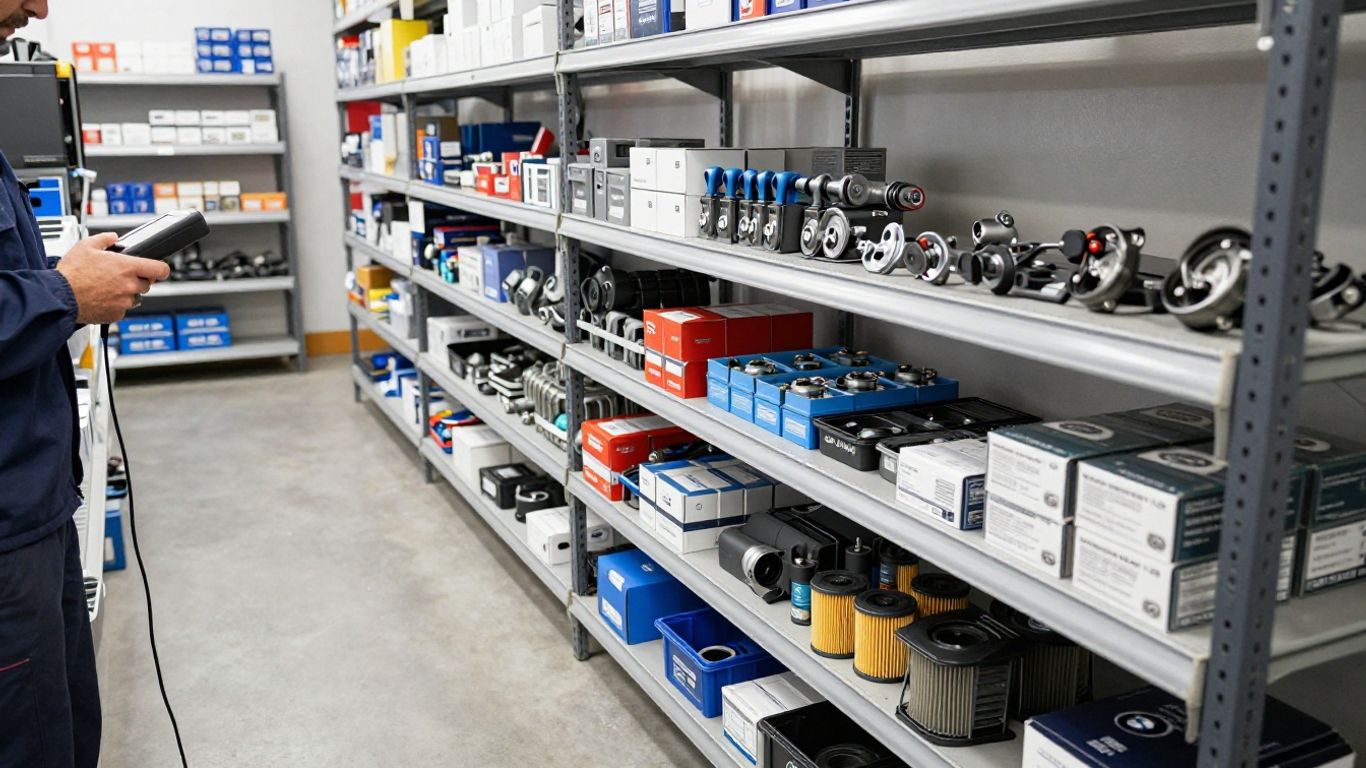
The visual organization of the storage area matters, but it is only part of the system. Clear location codes, consistent labeling, and accurate quantity records make the inventory easier to use during busy repair days.
Stocking high-demand maintenance and repair components
Begin with historical demand rather than assumptions about what “usually” fails. Review oil and air filters, spark plugs, belts, common seals, brake components, wiper parts, batteries, and other items that appear regularly on completed repair orders. Separate fast-moving items from parts that are merely expensive or memorable.
Stock levels should also account for supplier lead time and vehicle mix. A shop that frequently services older vehicles may need a different mix from one that sees newer models with more electronic systems. Periodic review prevents the shelf from becoming a collection of parts selected without reference to actual work.
Setting reorder points for slow-moving parts
Slow-moving parts require a different approach from high-volume consumables. Set a reorder point based on expected demand, supplier lead time, and the cost of being without the item. For some components, ordering only after a confirmed repair is safer than carrying multiple units that may become obsolete.
A reorder point should not be static if demand or delivery conditions change. Review it after seasonal shifts, supplier disruptions, changes in the local vehicle population, or a new service offering. Even a basic spreadsheet can flag when a low-use item is being reordered too early or when a critical part needs earlier action.
Organizing parts by model, system, and service frequency
Parts can be arranged by a combination of vehicle family, system, and service frequency. Frequently used items should be easy to reach, while sensitive electronic components need appropriate protection from moisture, impact, heat, and static. Bin labels should include the part number and a plain-language description so that a quick visual check can catch an error.
Avoid relying on memory for similar-looking components. Separate left and right versions, front and rear applications, and parts with different connectors or production ranges. When a component fits several vehicles, link those applications in the inventory record instead of duplicating vague descriptions across multiple bins.
Reducing losses from obsolete or incorrect inventory
Obsolescence often begins with an incorrect order that is never returned, a superseded number that was not updated, or a part placed in the wrong location. Set a short receiving routine for checking fitment and return eligibility before the packaging is discarded. If a part is assigned to a repair order, mark that reservation clearly so it is not sold or installed elsewhere.
Review aged inventory at planned intervals. Some items can be returned, transferred, used on a scheduled repair, or sold through an approved channel, while others should be written down and removed from active stock. Prompt decisions usually recover more value than leaving uncertain parts on the shelf for another year.
Control repair costs and protect profit margins
Repair profitability depends on more than the purchase price of a component. Labor, shipping, diagnostic time, installation difficulty, programming, rework risk, warranty administration, and vehicle storage all contribute to the final cost. A part decision that looks favorable on an estimate can become unprofitable if those surrounding costs are ignored.
Cost control should remain compatible with safe, durable repairs. The shop needs a method for comparing options without automatically choosing the cheapest listing. That method should also produce an explanation customers can understand, especially when two parts carry different warranties or installation requirements.
Calculating total landed cost beyond the purchase price
Total landed cost begins with the part price but also includes freight, taxes, core charges, special handling, and return exposure. Add the technician’s time to inspect, install, and verify the component, along with any required programming or calibration. For urgent repairs, the cost of a delayed vehicle may be relevant as well.
A written cost comparison is useful when the options have different delivery dates or warranty terms. It allows the estimator to see whether a slightly more expensive part reduces labor risk or avoids a second shipping charge. The calculation need not be complicated; it simply needs to include costs that would otherwise remain invisible.
Comparing part options by labor time and expected lifespan
Two parts with the same basic function may not create the same repair outcome. Compare access time, included hardware, preparation requirements, adjustment needs, and the likelihood of additional work. Then consider the expected service life and the consequences if the component fails early.
The most economical option is often the one that provides a reasonable balance between acquisition cost, installation effort, reliability information, and warranty support. This is not a promise that a particular category will always last longer. It is a reminder to judge the whole repair rather than one line on the invoice.
Communicating OEM and aftermarket choices to customers
Customers should receive a plain explanation of the available choices, including the part category, warranty, expected delivery, and any difference in installation or setup. Avoid technical shorthand that makes the decision seem mysterious. A customer can make an informed choice when the shop explains what is known and what trade-offs remain.
The estimate should also identify whether a selected option changes the repair plan. For example, a component may require a different verification step, have a different return condition, or carry a different warranty process. Written approval helps align expectations and gives the technician a clear record of the customer’s decision.
Tracking warranty claims, comebacks, and parts-related delays
Track every comeback that may involve a component, installation, diagnosis, or fitment error. Record the vehicle, part number, supplier, date installed, symptoms, diagnostic findings, and resolution. Patterns often emerge only after several months, particularly with parts that are used across multiple model families.
Parts-related delays deserve the same attention. Note incorrect shipments, incomplete kits, late deliveries, damaged packaging, and slow warranty responses. These records can guide supplier reviews, inventory changes, estimate adjustments, and technician training without assigning blame before the facts are clear.
Improve installation and repair outcomes
A correctly sourced part still needs to be installed within the vehicle’s technical requirements. BMW repair procedures can involve system-specific diagnostics, tightening sequences, fluid handling, initialization, and post-repair checks. Skipping one of those steps may leave the vehicle with a fault that looks like a defective component.
Repair quality improves when the technician has the part information and procedure before work begins. The repair order should identify the component being installed, the reason for replacement, and any expected programming or calibration. This creates a handoff between estimating, parts, and the technician instead of treating installation as an isolated task.
Using BMW service information and diagnostic procedures
Service information should guide removal, installation, inspection, and verification. Diagnostic procedures are particularly valuable when a fault code can be caused by wiring, connectors, power supply, communication, or mechanical conditions rather than by the named component itself. Testing before replacement reduces unnecessary parts use and protects the shop from repeat repairs.
Technicians should document relevant test results and compare the final vehicle condition with the original complaint. A post-repair scan, road test, visual inspection, or functional check may be appropriate depending on the system. The exact procedure should follow the applicable service information and the vehicle’s configuration.
Pairing replacement parts with required programming or coding
Some replacement modules and electronic components may need programming, coding, initialization, or adaptation after installation. The requirement should be identified during estimating so the shop can confirm equipment, software access, battery support, and technician time. If outside assistance is needed, schedule it before the vehicle is disassembled.
The repair record should state what setup was performed and whether the final test was successful. This is useful for warranty documentation and for future technicians who may otherwise assume that a new component was ready to operate immediately. It also prevents a programming step from being mistaken for an unexplained diagnostic delay.
Handling calibration for sensors, cameras, and driver-assistance systems
Sensors and cameras require particular care because their physical position and operating environment can affect system performance. A replacement may require calibration after installation, wheel alignment, glass work, suspension work, body repair, or another change that alters the vehicle’s geometry. The shop should identify the calibration requirement before promising a delivery time.
Calibration planning includes suitable equipment, a controlled workspace, correct tire and alignment conditions, and a final confirmation that relevant warnings have been resolved. A scan alone may not prove that a camera or sensor is correctly calibrated. Follow the applicable procedure and retain the result with the repair documentation.
Documenting parts used for future service and warranty records
Record the installed part number, supplier, brand or category, quantity, date, mileage, technician, and any associated core or warranty information. Include superseded numbers when they explain why the ordered and installed numbers differ. Attach photographs or test results when the condition of the old or new component may matter later.
Good records help with future diagnosis, customer questions, maintenance planning, and warranty claims. They also show which choices have performed well in the shop’s own vehicle population. Over time, that history becomes a practical source of information for estimates and purchasing decisions.
Conclusion
Sourcing BMW parts for repair shops is a process of matching the right component to the right vehicle, repair objective, budget, and installation procedure. Shops that verify fitment, inspect quality, manage inventory, measure total cost, and document electronic setup are better positioned to deliver predictable repairs. The result is not simply a lower parts bill, but fewer delays, clearer customer conversations, and more consistent workmanship.