

Key Takeaways
A BMW insurance claim is easier to manage when the policy, estimate, parts selection, and repair records all tell the same story.
- Check whether the policy covers OEM parts or allows other replacement types.
- Ask the repair center to document visible, hidden, and newly discovered damage.
- Compare fitment, safety, warranty, and price rather than looking only at the estimate total.
- Confirm calibration, programming, diagnostics, and refinishing are included when needed.
- Keep written records and review the completed repair before signing off.
Understand how BMW parts affect an insurance claim
The parts listed on an insurance estimate can affect more than the initial price. They may influence fit, appearance, warranty discussions, and the steps a repair center must take after installation. Before approving work, learn what each replacement category means and how the estimate may change as the vehicle is disassembled.
OEM, aftermarket, recycled, and remanufactured parts
OEM parts are made for the vehicle manufacturer, while aftermarket parts come from other suppliers. Recycled parts are recovered from another vehicle, and remanufactured parts have been restored or rebuilt for reuse. The label alone does not settle whether a part is appropriate; the vehicle’s age, condition, damage pattern, and policy language all matter.
A written estimate should identify the proposed part type instead of using vague wording such as “replacement.” Ask whether the part is new, used, recycled, or remanufactured, and request the supplier or part number when available. That information makes later comparisons much easier.
Why part quality matters for BMW safety and performance
A replacement part needs to fit the vehicle and work with the systems around it. A bumper cover, lighting component, sensor bracket, suspension piece, or body panel can involve more than its visible surface. Poor fitment may create extra refinishing work, while an incorrect component can complicate diagnostics or calibration.
For that reason, part quality affects more than appearance. Discuss the proposed part with the repair center, particularly when the damaged area includes driver-assistance sensors, restraint components, steering, suspension, lighting, or structural elements.
How state laws can influence replacement-part requirements
State rules may govern disclosures, consent, estimates, or the use of non-OEM parts. Requirements can also differ depending on whether the claim is handled under your policy or another driver’s liability coverage. A general internet answer cannot replace the law and policy terms that apply to your location.
Ask the insurer how it applies the relevant rule and request the explanation in writing. If the answer is unclear, your state insurance department or a qualified local professional may help clarify the process without deciding which part is best for the vehicle.
The difference between an insurer’s estimate and the final repair cost
An insurer’s first estimate is often based on what an adjuster can see before teardown. Once panels, trim, or components are removed, the repair center may find damage that was not visible initially. The final cost can therefore include supplements, additional labor, revised parts, and procedures that were not known at the beginning.
Treat the first estimate as a starting document, not necessarily the final repair plan. Compare it with the repair center’s findings and ask how disagreements will be handled before work progresses.
Review your policy before approving repairs
Your policy sets the boundaries for the claim, but its wording may be easy to overlook when a damaged vehicle is waiting for repairs. Find the declarations page, endorsements, exclusions, deductible, and claim instructions before authorizing parts. A short call with the insurer can prevent an expensive misunderstanding.

OEM parts endorsements and manufacturer-specific coverage
Some policies include an OEM-parts endorsement or another provision that changes how replacement parts are selected. Others may permit non-OEM parts under certain conditions, sometimes with disclosure or a difference in cost. Do not assume that a newer or more expensive vehicle automatically has OEM-only coverage.
Look for exact terms concerning original equipment, replacement parts, manufacturer-specific coverage, and any age or mileage limits. If the policy does not answer the question clearly, ask the insurer to identify the applicable provision rather than relying on a verbal promise.
Collision and comprehensive coverage considerations
Collision coverage generally addresses damage from a crash, subject to the policy’s terms and deductible. Comprehensive coverage may apply to events such as theft, weather, falling objects, or animal contact, again depending on the contract. The type of loss can affect the claim path, inspection process, and coverage questions.
Confirm which coverage is being used, who is responsible for the deductible, and whether another driver’s insurer is involved. Keep those details separate from the technical question of which part belongs on the vehicle; coverage and repair quality are related but not identical issues.
Deductibles, limits, and depreciation
The estimate total is not always the amount you will receive or owe. A deductible may be subtracted, policy limits may cap payment, and depreciation or actual-cash-value rules may apply in some situations. If the vehicle is close to a total-loss threshold, the claims conversation may shift from repair costs to valuation.
Write down the insurer’s calculation and ask for a line-by-line explanation. This is especially useful when a parts substitution, betterment charge, or added work changes the amount you expected.
Restrictions related to repair shops or parts suppliers
Some policies include preferred repair networks or procedures for selecting a shop, while many jurisdictions protect an owner’s ability to choose a repair facility. The practical details vary, so check both the policy and local requirements. A referral from an insurer is not the same thing as a guarantee that the shop will use a particular part.
Before the vehicle is moved or repairs are approved, ask who is responsible for ordering parts, whether the shop can challenge the estimate, and how supplements will be submitted. Clear answers reduce delays later.
Build a strong BMW damage estimate
A useful estimate connects the accident evidence to the work required to return the vehicle to safe, proper condition. It should account for what can be seen, what may be hidden, and what must be tested after installation. Photos and careful notes give the adjuster a much stronger basis for approving the work.
Documenting visible and hidden damage
Take photographs from several distances before repairs begin, including the surrounding panels, wheels, glass, lights, interior, and ground beneath the vehicle. Include close views of gaps, cracks, fluid leaks, deployed restraints, and warning messages when it is safe to do so. The repair center’s teardown findings should then be attached to the claim as supplemental documentation.
Do not treat a clean exterior as proof that no internal damage exists. Mounting points, brackets, wiring, cooling components, and suspension parts can require inspection even when the most obvious damage is limited to a bumper or fender.
Identifying the correct BMW part numbers
Part numbers help distinguish a proposed component from a similar-looking alternative. Ask the repair center to verify the number against the vehicle identification number, model year, equipment, and side of the vehicle. Differences in trim, lighting, sensors, or drivetrain can make an apparently interchangeable part unsuitable.
If the estimate lists only a generic description, ask for more detail. A precise part reference also helps when comparing the insurer’s estimate with the repair center’s plan.
Including calibration, programming, and diagnostic procedures
Modern collision repairs may require scans before and after work, programming, aiming, calibration, or a road test. Whether a particular procedure applies depends on the damaged system and the repair performed. The estimate should identify those operations rather than burying them inside a general labor line.
Ask who will perform each diagnostic or calibration step and what record will show that it was completed. Omitting required procedures at the estimating stage can create both a payment dispute and an unsafe handoff.
Accounting for labor rates, refinishing, and shop materials
Labor is more than the number of hours shown beside a body panel. The estimate may need separate operations for removal and installation, corrosion protection, measuring, structural work, paint preparation, blending, and final assembly. Refinishing materials, fasteners, clips, adhesives, and shop supplies can also affect the total.
A clear estimate makes assumptions visible. Compare labor categories and rates line by line, then ask the repair center to explain any operation that appears absent or bundled into another entry.
Compare OEM and non-OEM BMW replacement parts
Choosing between OEM and non-OEM parts is not simply a contest between a high price and a low price. The right comparison considers the part’s role, construction, fitment, availability, warranty, and effect on related systems. It should also account for what the policy permits and what the repair center can stand behind.
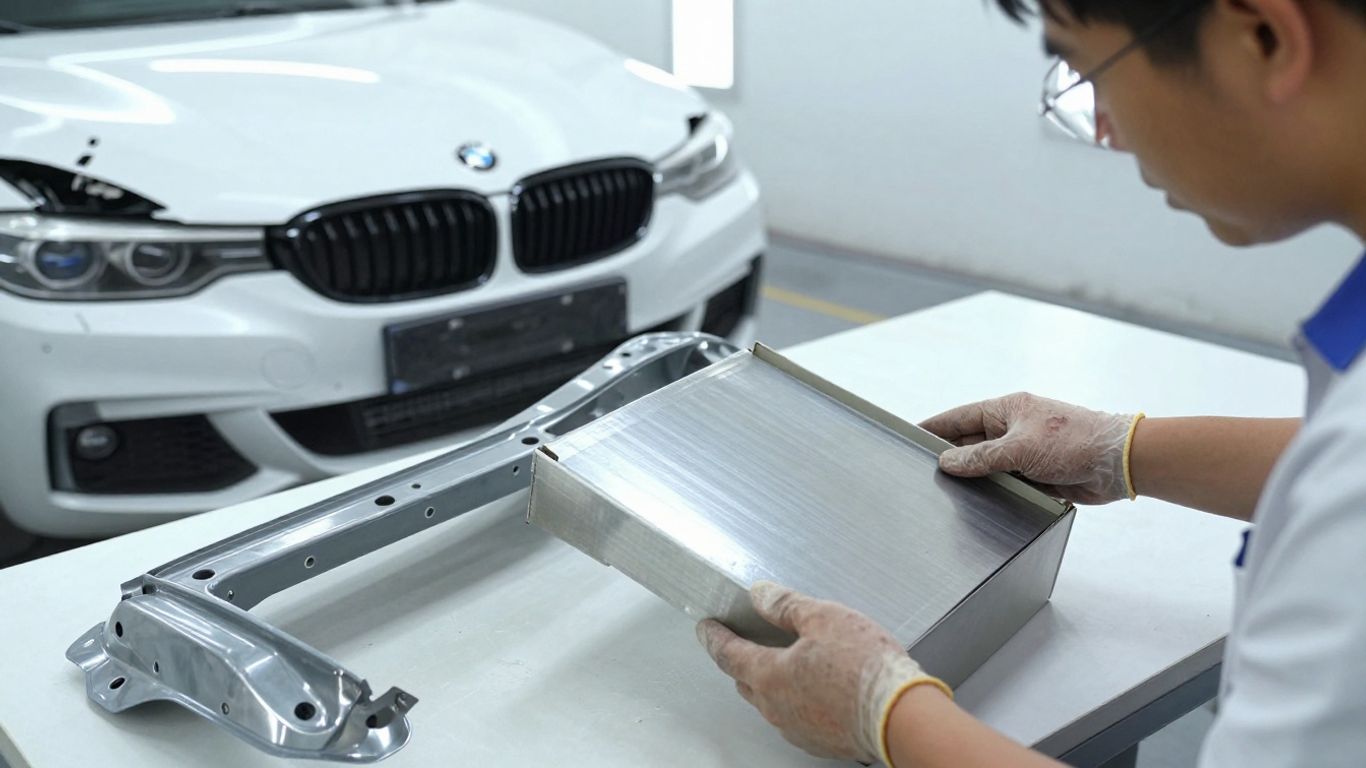
Safety and fitment differences
A body panel may raise different concerns from a sensor, restraint component, headlamp, wheel, or suspension part. The more closely a component interacts with safety systems or vehicle electronics, the more carefully its specifications and installation requirements should be checked. Even a cosmetic part can create extra work if its contours or mounting points do not match.
Ask how the proposed part has been verified for the specific vehicle. Fitment should be assessed before paint and final assembly, when correcting a mismatch is less disruptive.
Warranty and long-term reliability considerations
Find out what warranty covers the part, who administers it, and whether labor is included if the component fails. A supplier warranty, repair-center warranty, and vehicle manufacturer warranty may not offer the same protection. Keep the terms with the claim records rather than assuming every warranty is interchangeable.
Reliability also includes future service. A lower upfront price may be less attractive if the part is difficult to diagnose, requires repeated adjustment, or has uncertain availability later.
When aftermarket or recycled parts may be acceptable
Aftermarket or recycled parts may be reasonable in some repairs when they are properly specified, available, and appropriate for the vehicle’s condition. A recycled component can sometimes preserve a matching finish or provide a practical solution for an older vehicle. Acceptance should still be based on condition, fit, function, and the repair center’s assessment.
Discuss the choice before the part is ordered. If a substitute is proposed, ask what inspection or testing will confirm that it is suitable and whether the insurer will disclose the substitution as required.
How to evaluate cost savings against potential risks
Compare the complete repair impact, not just the price printed next to the part. A cheaper component may require additional labor, paint adjustment, hardware, diagnostic work, or replacement if it does not fit. Conversely, a suitable recycled or aftermarket component may reduce cost without creating a meaningful problem in a particular repair.
A simple written comparison can help: part price, added labor, warranty, expected availability, related procedures, and the owner’s out-of-pocket difference. This keeps the decision grounded in evidence instead of pressure at the estimate counter.
Work with a BMW-certified collision repair center
A repair center familiar with the vehicle can help translate technical damage into a clear claim file. Certification language, training, and equipment should be verified rather than assumed from a shop’s branding or online listing. The insurer still controls its coverage decision, but a well-documented repair plan gives everyone better information.
Benefits of BMW repair procedures and technical information
Manufacturer repair procedures can specify preparation, joining methods, measuring, component replacement, and post-repair checks. A center that can access and follow the applicable technical information may be better positioned to explain why a line item belongs in the estimate. The procedure should match the damaged area and the actual repair method.
Ask the center which repair information it will use and how that information affects the estimate. This keeps the discussion specific instead of relying on broad claims about quality.
Verifying technician training and equipment
Ask whether the technicians have training relevant to the vehicle and whether the facility has the measuring, scanning, refinishing, welding, and calibration equipment required for the proposed work. The answer should relate to this repair, not merely to the shop’s general capabilities. You can also ask who will complete the final inspection.
A confident repair plan explains what will be done, what will be tested, and what records will be delivered. Those details are more useful than a vague assurance that the shop has handled similar cars.
Coordinating directly with the insurance adjuster
The repair center and adjuster should have a clear method for exchanging photographs, estimates, supplements, and approvals. Ask for copies of important communications and learn who must authorize a change in parts or labor. That process can keep the owner from becoming the only messenger between two parties.
Stay involved even when the shop and insurer communicate directly. A brief written update after each major decision helps confirm that you understand what has been approved and what remains under review.
Confirming parts approval before disassembly and repairs
Before authorizing work, ask which parts are approved, which remain disputed, and whether teardown is needed to identify hidden damage. Approval may cover an estimate without resolving every question about substitutions. Make sure the repair center knows whether you accept a proposed part type or want the issue reviewed first.
Written confirmation is especially valuable when a part is back-ordered or when a change could affect the repair schedule. It gives the shop a clear instruction and gives you a record if the claim later changes.
Handle disputes over BMW parts and claim payments
Disagreements often begin with a single line on an estimate but can grow when conversations remain informal. Keep the focus on the vehicle, the policy, the documented damage, and the work needed. Calm, specific questions usually produce more progress than a general demand to “fix the estimate.”
Requesting a written explanation for parts substitutions
If the insurer proposes a non-OEM, recycled, or remanufactured part, ask for the part description, source, price, warranty, and reason for the substitution. Ask the repair center to explain any fitment or procedure concern in writing as well. This creates a shared record rather than leaving the decision to a quick phone call.
Review the policy language alongside the explanation. If the proposed part is allowed, the remaining discussion may concern suitability, cost differences, or owner-paid upgrades; if it is not allowed, the relevant coverage provision becomes central.
Challenging an estimate that omits necessary repairs
An objection is stronger when it identifies a missing operation and connects it to evidence. Use photographs, teardown notes, scan results, manufacturer procedures, measurements, and the repair center’s written explanation. Ask the adjuster to approve the item, inspect it, or explain why it is excluded.
Avoid approving a final repair plan while a known safety-related item is still unresolved. A short email summarizing the disputed line and requested response date can make the claim easier to track.
Using supplements for hidden or newly discovered damage
A supplement updates the estimate when disassembly reveals additional damage or when the repair method changes. The repair center commonly documents the discovery with photographs and a revised estimate, but the owner should request a copy. New damage can include brackets, wiring, cooling components, fasteners, or structural areas hidden behind exterior panels.
The supplement should show what changed and why. Once the insurer reviews it, compare the revised approval with the actual repair plan before the next stage begins.
Escalating unresolved disagreements through appraisal or regulators
If routine discussions do not resolve a payment dispute, review the policy for appraisal, mediation, or other procedures. Those options may address the amount of loss but not every coverage or workmanship issue. A state insurance regulator may also explain complaint procedures and applicable requirements.
Keep escalation factual and organized. Provide the policy provision, estimates, photographs, correspondence, disputed items, and the response you are requesting; avoid sending a large, unindexed collection of documents.
A documented question is easier to resolve than a disputed memory.
That principle matters when several parties are discussing parts, supplements, and payment at different times. A clear record lets each person respond to the same facts.
Protect your records throughout the repair process
The claim file should follow the vehicle from the first photographs through the final inspection. Save digital copies in one place and name files with the date and subject. Good records protect you if a payment question appears later, and they also help identify what was actually repaired.
Keeping photos, estimates, invoices, and claim correspondence
Keep the original damage photos, inspection reports, estimates, supplements, invoices, receipts, emails, text messages, and notes from calls. Record the date, speaker, and main decision after a phone conversation. Include claim numbers and vehicle details in file names so documents do not become disconnected from the event.
Do not discard an early estimate after receiving a revised one. Comparing versions may reveal a deleted operation, changed part type, or new deductible calculation.
Confirming part types before installation
Before installation, ask the repair center to identify which parts are OEM, aftermarket, recycled, or remanufactured. Compare that list with the approved estimate and any written agreement about substitutions. If a part changed because of availability, request the revised approval before the vehicle moves to the next repair stage.
Photograph labels, packaging, or part markings when practical and permitted. The goal is not to inspect every component personally, but to preserve enough information to answer a later question.
Reviewing alignment, diagnostics, and calibration results
Request records for wheel alignment, scans, system checks, calibrations, and other procedures relevant to the damage. The exact documents will depend on the repair, but the repair center should be able to explain what was tested and whether any issue remains. Warning lights, unusual handling, panel gaps, wind noise, or inconsistent lighting deserve attention before acceptance.
Review these results with the repair center instead of treating them as paperwork only. A completed test record is useful when it is connected to the systems repaired and the symptoms observed.
Checking the completed repair before signing off
Inspect the vehicle in good light before signing a completion document. Check paint match, panel gaps, trim, glass, lights, wheels, tires, doors, trunk operation, interior condition, warning messages, and cleanliness. Take a short drive only when the repair center confirms the vehicle is safe to operate.
If something is wrong, describe it in writing and ask how it will be corrected. Do not let urgency replace a careful handoff; a small issue is usually easier to address when it is identified before the claim is closed.
Conclusion
Handling BMW parts for insurance claims is mostly a matter of careful comparison and steady documentation. Read the policy, build an estimate that includes necessary procedures, question substitutions respectfully, and keep the repair center and insurer working from the same written facts. That approach cannot guarantee a particular coverage decision, but it gives you a clearer basis for protecting the vehicle and evaluating the finished repair.